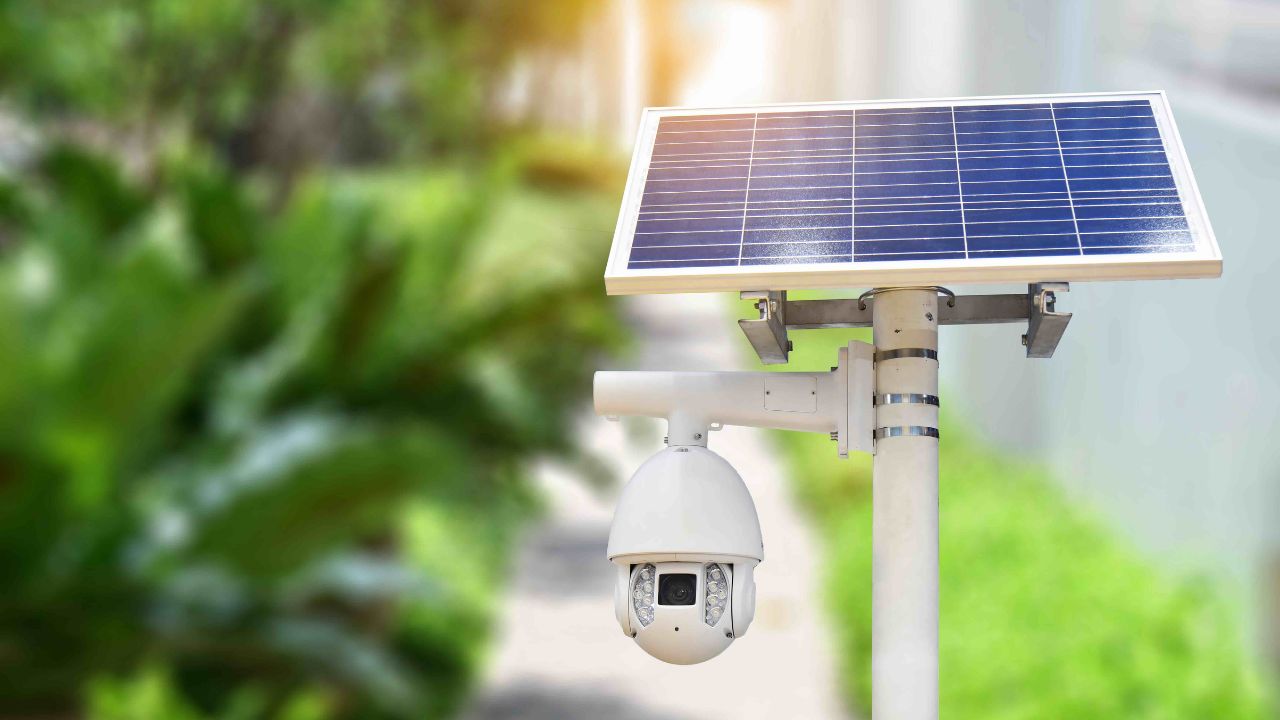
Modern engineering, new materials, and intelligent system integration are changing the solar camera industry in a remarkable way. The manufacturers are changing their designs to enhance their performance, durability, and user experience due to the increased demands of wireless and energy-saving surveillance across the globe. These new design trends are changing the manner in which these solar cameras are designed, fabricated, and also implemented in various environments, whether at home or in remote industrial areas.
Evolution of Solar Power Integration
The main development in solar camera production is the way solar panels and batteries are being incorporated into the products. Early solar cameras were based on small panels with limited capacity, which usually needed to be recharged frequently or supplied with accompanying panels. This is being replaced by larger, high-efficiency, and better conversion rates, giving manufacturers greater power output even in low sunlight areas.
New design features include monocrystalline solar cells, adjustable panel mountings, and smart power control. The features enable the camera to meet the seasonal variations, maximize the charging angles, and provide 24/7 continual surveillance. The lithium and LiFePO4 batteries are also long-lasting, ensuring long-lasting power autonomy and reducing maintenance while prolonging the life of the gadget.
Advanced Multi-Lens and PTZ Capabilities
The development and advanced sophistication of modern solar cameras have advanced to a single-lens version. To enhance coverage and the elimination of blind spots, manufacturers are incorporating the dual-lens, triple-lens, and PTZ (pan-tilt-zoom) technology. These high-tech optical systems enable one camera to provide a panoramic picture, zoom in on the object at a distance, and even follow a movement more precisely.
Multi-lens designs are a combination of wide-angle and telephoto lenses, and are created to have a hybrid zoom property without reducing the quality of images. The PTZ capabilities have also been made more efficient as the camera can now move easily to bring a sense of motion and to react to the movement in real-time. These upgrades also go a long way in increasing the monitoring capabilities, especially in large outdoor locations.
Smarter AI-Driven Detection Systems
Artificial intelligence has come to be an integral part of the design of solar cameras nowadays. Manufacturers have gone further to incorporate AI-based algorithms that differentiate between humans, cars, animals, and irrelevant motion. It decreases false alarms and enhances detection.
Advanced AI systems are capable of providing provisions like auto tracking, personalized detection areas, and real-time alerts. ERP enables manufacturers to have a better view of things during difficult light conditions, quick reaction time, and intelligent and smart recording of events by integrating AI with better image sensors. Such upgrades enable the solar cameras to be used as intelligent security systems, but not mere recording machines.
Improved Connectivity and Smart Home Integration
New designs are also changing the connection as well as the communication of solar cameras. To guarantee the constant stability in the performance of devices in different locations, manufacturers now offer the features of dual-band Wi-Fi, strong-range antennas, and 4G/5G cellular connection in order to cover remote areas that lack internet access.
The integration of smart homes has gained priority. The innovation of modern designs enables a camera to be compatible with mobile applications, voice assistants, and cloud platforms. The user will be able to view live feeds, issue alerts, and manage camera settings anywhere. These connectivity innovations enhance the convenience of the users and enable solar cameras to be a component of a larger smart security system.
Customization and Modular Design Trends
The design concept of modular designs is becoming more popular among manufacturers, who can therefore design their goods to fit the particular market demands more easily. Enterprises have the right to order customized lodgings, enhanced lenses, included solar setups, or customized mobile applications. Modular components make it possible to assemble faster, repair more easily, and be more adaptable to fit various environments.
It is also a method that enables manufacturers to develop quick innovations to add new features to a product or another design without necessarily changing the complete production line. Adaptable features also enable the solar cameras to be more attractive to distributors, wholesalers, and brands that want to have unique products.
Conclusion
New designs are spurring a new generation in the creation of solar cameras, which can be characterized in terms of power and AI intelligence, as well as durability and network handling. The developments have helped manufacturers provide smarter, stronger, and flexible security solutions that address the changing needs of contemporary surveillance. With the further development of technology, solar cameras will have an even more significant influence on the future of wireless and eco-friendly security systems.